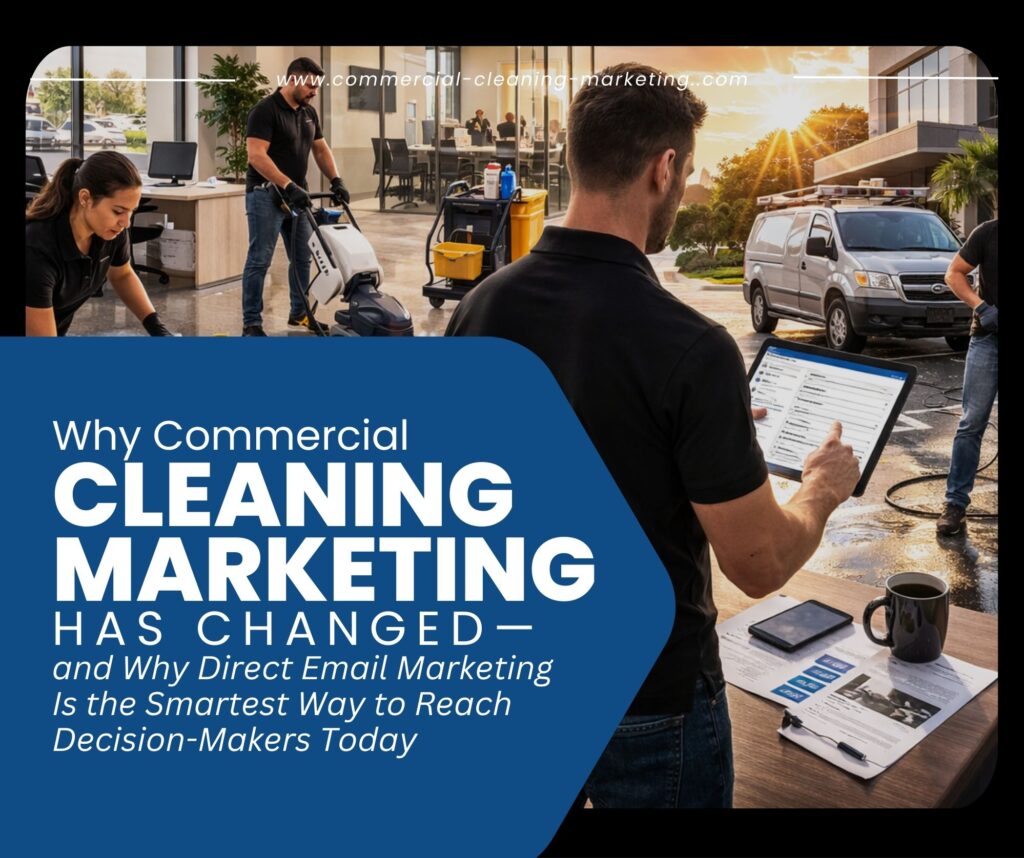
Commercial cleaning is built on trust.
A facility manager is not choosing someone to clean a small corner of an office once. They are choosing a company that may enter their building every night, care for expensive surfaces and equipment, work around employees and tenants, and maintain the appearance of the facility week after week.
That kind of relationship usually isn’t created from a single advertisement.
It develops through familiarity, credibility, communication, and consistent follow-up.
This is why email marketing has become such an important part of commercial cleaning marketing. A well-planned email strategy helps cleaning companies stay visible to facility managers, property managers, office administrators, building engineers, and other decision-makers long before they are ready to replace their current cleaning provider.
The goal isn’t to bombard prospects with sales messages.
The goal is to become a familiar, credible company so that when a cleaning contract comes up for review, service quality declines, a new building opens, or a facility manager simply wants another proposal, your company is already known.
Consistency Makes Your Commercial Cleaning Company Easier to Trust
A prospect might first encounter your company through a Google search.
Later, they might see one of your social posts.
A colleague may mention your name.
Then one of your emails arrives with a useful facility-maintenance tip.
A few weeks later, they visit your website.
Each interaction should feel like it came from the same business.
Brand consistency doesn’t mean every message needs to look or sound identical. It means prospects should develop a clear impression of who you are, what types of facilities you clean, where you operate, and what they can expect if they contact you.
Your website can explain services in depth.
Your social media can show your team, projects, expertise, and personality.
Your emails can provide useful information and maintain the relationship.
Your sales team can follow up personally.
When these pieces work together, marketing becomes much more powerful than sending an occasional sales email whenever business slows down.
This is also why commercial cleaning marketing is different from regular marketing. You aren’t necessarily trying to generate an immediate online purchase. You’re building recognition and trust around a service relationship that may be worth thousands or even tens of thousands of dollars over time.
Build an Email List That Fits the Business You Actually Want
A database containing 100,000 email addresses isn’t necessarily better than a carefully selected list of 5,000 prospects.
The value comes from who is on the list.
Before building an email campaign, commercial cleaning companies should determine what kind of business they actually want.
Ask questions such as:
- What geographic area can we serve efficiently?
- What size facilities are profitable for us?
- Which industries do we understand particularly well?
- What cleaning services can our crews deliver consistently?
- How far are we willing to travel?
- What size account would justify a walkthrough?
- Which types of accounts do we want more of?
A company specializing in large office buildings should not necessarily market the same way as a company pursuing medical facilities, schools, warehouses, industrial properties, or smaller professional offices.
Your list should reflect your business model.
This is one of the most important principles in generating better commercial cleaning leads.
You don’t simply need more leads.
You need more opportunities that make sense for your company.
Make Sure You Can Handle the Accounts You’re Marketing For
Growth is exciting until operations can’t support it.
Before launching an aggressive campaign, evaluate:
- Staffing
- Supervisors
- Equipment
- Transportation
- Supply requirements
- Training
- Current contracts
- Crew schedules
- Geographic coverage
Imagine successfully generating walkthroughs for three large facilities and winning all three contracts within several weeks.
Could your company onboard them properly?
Could you staff them without hurting service at existing accounts?
Could supervisors handle the additional workload?
Marketing should create sustainable growth rather than operational problems.
A good campaign considers not only who might buy, but also who you are prepared to serve well.
Segment Your Email List by Industry
One of the biggest mistakes in commercial cleaning email marketing is treating every prospect as though they have the same needs.
They don’t.
A medical facility has different priorities from a warehouse.
A corporate office is different from a school.
An industrial facility is different from a multi-tenant office building.
This is where segmentation becomes valuable.
Instead of sending one generic email to everyone, divide your database into meaningful categories.
Medical Facilities
Messages might discuss:
- High-touch areas
- Cleaning schedules
- Patient-facing spaces
- Restrooms
- Staff coordination
- Consistency
- Documented cleaning processes
Office Buildings
Content might focus on:
- Tenant satisfaction
- Restrooms
- Break rooms
- Common areas
- Nightly cleaning
- Day porter services
- Professional appearance
Warehouses and Industrial Facilities
Topics might include:
- Floor care
- Employee areas
- Restrooms
- Break rooms
- Shift schedules
- Large-space cleaning
- Safety considerations
Schools and Educational Facilities
Emails might discuss:
- High-traffic areas
- Restrooms
- Classrooms
- Common spaces
- Seasonal cleaning
- Scheduling around building use
The point isn’t to pretend you know exactly what every facility needs.
The point is to demonstrate that you understand that different facilities create different cleaning challenges.
That makes the communication considerably more relevant.
Segment by the Person You’re Talking To
Industry isn’t the only useful way to divide an email list.
Different people inside the same organization may view commercial cleaning differently.
A facility manager might care about consistency, inspections, staffing, and communication.
A property manager may care about tenants, appearance, complaints, and vendor reliability.
An office manager may be the person hearing complaints about kitchens, trash, restrooms, or common areas.
A building engineer may see operational issues before anyone else.
A business owner may focus heavily on value, professionalism, and whether the cleaning company makes facility management easier.
You don’t necessarily need a completely separate campaign for every job title, but understanding the audience makes your emails considerably stronger.
Stop Sending Emails That Only Say “Do You Need Cleaning?”
Imagine receiving this message every month:
Are you looking for a new commercial cleaning company? Call us for a quote.
There is nothing inherently wrong with the offer.
But after receiving essentially the same message repeatedly, most people stop paying attention.
A stronger commercial cleaning email strategy provides a reason to stay connected.
For example:
What should a facility manager look for during a cleaning walkthrough?
Five areas commonly missed during nightly office cleaning
When should a commercial cleaning scope of work be updated?
How do you transition from one janitorial company to another?
What should be included in a commercial cleaning proposal?
How can facility managers reduce recurring cleaning complaints?
What should you inspect before renewing a janitorial contract?
Now the email has value even if the recipient isn’t ready to switch providers today.
And that’s important because timing plays a huge role in commercial cleaning sales.
The Prospect May Not Need You Today
This is one of the reasons email works so well for commercial cleaning.
A facility manager may receive your email today and have absolutely no interest in changing vendors.
Their current company may be doing a good job.
Six months later, everything could be different.
Service quality declines.
The cleaning company loses a supervisor.
Employees begin complaining.
Restrooms aren’t being maintained properly.
The facility expands.
A new property manager arrives.
The contract expires.
A budget changes.
Suddenly the facility manager needs alternatives.
If your company has communicated professionally for the previous six months, you’re no longer a complete stranger.
That’s the power of nurturing.
One Email Rarely Wins the Contract
Commercial cleaning companies sometimes evaluate email campaigns too quickly.
They send one campaign.
Nobody immediately requests a $100,000 cleaning contract.
They decide email doesn’t work.
But commercial cleaning isn’t usually an impulse purchase.
The real process may look more like this:
Email → recognition → another email → website visit → social post → another email → internal discussion → reply → phone call → walkthrough → proposal → follow-up → contract.
That’s why consistency matters.
The campaign supports the relationship until timing and need align.
Use Email to Generate Walkthroughs
For many commercial cleaning companies, the most valuable conversion isn’t an online sale.
It’s the walkthrough.
A qualified walkthrough gives the cleaning company an opportunity to understand:
- Facility size
- Flooring
- Restrooms
- Kitchens
- Common areas
- Cleaning frequency
- Existing problems
- Access requirements
- Scheduling
- Expectations
- Special services
That information allows the company to prepare a much more accurate proposal.
Your email therefore doesn’t need to close the entire deal.
It often needs to accomplish one thing:
Start the conversation.
A simple CTA may be:
Would it make sense to schedule a walkthrough?
or:
If your facility is reviewing its cleaning service, reply and we can discuss what you’re looking for.
That’s much more natural than turning every email into a high-pressure sales pitch.
Reach the People Who Know the Building
The person who signs the cleaning agreement isn’t always the first person who notices a problem.
Building engineers, maintenance supervisors, office managers, property staff, and other people working inside the facility may understand the day-to-day condition of the property extremely well.
They may know:
- Where recurring problems occur
- Whether the current cleaning provider misses details
- When new tenants are moving in
- Whether renovations are planned
- When contracts may be reviewed
- Who manages vendor relationships
These people can become valuable professional connections.
The key is to approach them respectfully.
Build relationships rather than putting people in uncomfortable positions.
Email can support those relationships with useful follow-up after a conversation or introduction.
Connect Email Marketing With a CRM
As your prospect list grows, remembering every conversation becomes difficult.
Someone replied three months ago.
Another prospect asked you to contact them next quarter.
Someone requested information but wasn’t ready for a walkthrough.
A property manager moved to another company.
A facility is reviewing vendors in January.
Without a system, valuable opportunities disappear.
That’s where a CRM can become an important part of the process.
The relationship between marketing and a CRM is especially important for commercial cleaning companies because many opportunities require long-term follow-up.
Your CRM can help organize:
- Contacts
- Companies
- Facility types
- Conversations
- Follow-up dates
- Walkthroughs
- Proposals
- Sales stages
- Notes
Email generates visibility.
The CRM helps your team remember what happens next.
Make Every Message Sound Like Your Company
The strongest campaigns don’t rely on constant discounts or dramatic claims.
They communicate clearly.
Explain:
- What your company does
- Which facilities you serve
- Where you operate
- How your process works
- What customers can expect
- What problems you solve
If your crews follow documented checklists, explain that accurately.
If supervisors inspect work, describe the process.
If you specialize in specific building types, say so.
Specific information is more convincing than vague claims such as:
“We provide the best cleaning in town.”
Let your expertise demonstrate the value.
Keep Emails Easy to Read
Facility managers are busy.
Many read emails between meetings or while walking properties.
Keep messages straightforward.
Use:
- Clear subject lines
- Short paragraphs
- One central idea
- Useful information
- A recognizable sender
- A monitored reply address
- A simple CTA
- Mobile-friendly formatting
You don’t need every email to resemble a glossy advertisement.
Sometimes a straightforward email from a real person performs better because it feels like professional communication rather than another promotion.
Consistency Is More Important Than Sending Constantly
Commercial cleaning companies do not need to email prospects every day.
In fact, excessive communication can damage the relationship.
Choose a schedule you can sustain.
That might mean:
- Monthly educational emails
- Periodic industry-specific campaigns
- Seasonal reminders
- Personal follow-ups
- Occasional company updates
Plan topics in advance so marketing doesn’t disappear whenever operations become busy.
This is where a coordinated strategy for commercial cleaning marketing, branding, map listings, and email becomes valuable.
Email should not operate in isolation.
Measure What Produces Business
Open rates can be interesting, but they aren’t the final goal.
Commercial cleaning companies should pay attention to business outcomes.
Track:
- Replies
- Qualified conversations
- Walkthrough requests
- Walkthroughs completed
- Proposals
- Follow-ups
- Contracts won
- Contract value
If a campaign generates fewer clicks but produces three qualified walkthroughs, it may be far more valuable than an email that generates lots of engagement but no serious prospects.
The metric that matters most is ultimately business growth.
How Tiger Commercial Cleaning Marketing Can Help
Tiger Commercial Cleaning Marketing helps commercial cleaning companies turn scattered marketing efforts into a coordinated and repeatable program.
The process begins by understanding the business.
What services do you offer?
Which industries do you want?
Where do you operate?
What size facilities make sense?
How much additional business can you realistically handle?
From there, Tiger can help organize audiences, develop industry-specific email campaigns, strengthen messaging, support consistent branding, manage digital marketing, and create a schedule that doesn’t disappear when your company gets busy.
Email can also be coordinated with your website, social media, lead follow-up, and other marketing channels.
The objective isn’t simply to send more emails.
It’s to create consistent visibility among the right prospects.
Commercial Cleaning Marketing Works Best When Everything Supports Everything Else
A facility manager receives an email and visits your website.
The website clearly explains your services.
Later, they see a social post.
They search your company and find consistent business information.
They continue receiving useful communication.
Eventually, they need another cleaning proposal.
Now your company is familiar.
This is why marketing becomes stronger when the pieces reinforce one another.
The website supports email.
Email supports sales.
Social media reinforces the brand.
A CRM supports follow-up.
Reviews support trust.
And your sales team converts interest into walkthroughs and proposals.
Growth Comes From Showing Up Consistently
Commercial cleaning contracts are often won through a series of small moments.
Someone recognizes your name.
They see that your company understands their type of facility.
A building contact passes your information along.
An email arrives at the right time.
A facility manager visits your website.
Your team follows up.
Then comes the walkthrough.
Then the proposal.
Then another follow-up.
And eventually, the contract.
That’s why consistent email marketing can be so valuable.
A focused list, relevant messaging, recognizable branding, organized follow-up, and a sustainable schedule make commercial cleaning marketing more purposeful.
Start with accounts you can genuinely serve well.
Segment your audience by building type and role.
Answer real facility-management questions.
Build professional relationships.
Make requesting a walkthrough easy.
And above all, keep showing up.
The cleaning company that stays useful and visible doesn’t have to hope a facility manager somehow remembers its name at exactly the right moment.
It has been building that recognition all along.